


(Photo by Levi Meir Clancy on Unsplash)
Growing up, I would help my dad with so many weekend projects. One time, my high school replaced the wooden bleachers in the football stadium with metal ones. My dad asked if he could have the leftover wood, and he and I built a bunch of picnic tables. That was a fun Christmas break.
As a kid growing up helping with projects like this, you hear a lot of these phrases over and over again:
“Measure twice, cut once.”
“Haste makes waste.”
“A job worth doing is worth doing right.”
Perhaps the most valuable is: “Plumb, level, square.”
When you’re building something, you want it to be crisp and precise before you fasten the pieces together. So, you aim to stay plumb (vertically straight), level (horizontally straight), and square (90-degree angles at all corners).
In the New Testament, we read about a building project that’s underway.
Peter describes exiled Christians as the stones of a building that’s being built up into a spiritual house (1 Peter 2:4-8). Likewise, Paul writes to a fractured audience, calling them to see themselves as joint members of a household that’s being built on the foundation of the apostles and prophets (Ephesians 2:19-22).
Ultimately, for both Peter and Paul, the central emphasis is Christ, who is the cornerstone of the building (see Isaiah 28:16).
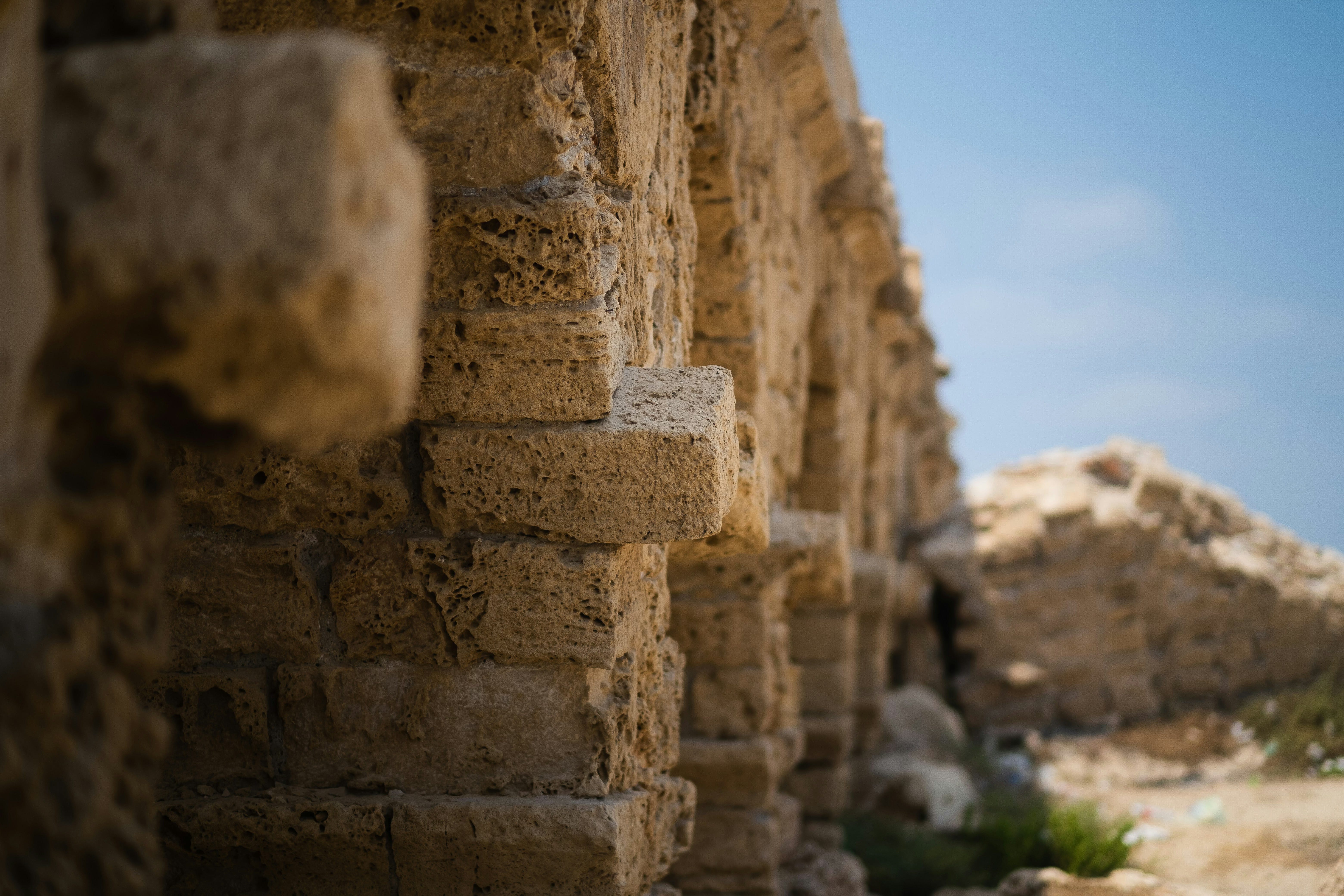
Don’t miss the metaphor. Both Peter and Paul are describing ancient masonry—construction with giant stones.
When we think of building things in the modern world, we might think of 2x4s—a stick-built home —or rebar, steel, and concrete for something bigger. But the principle is the same. Every building starts with that first piece. In the ancient world, that piece was the cornerstone.
Back then, the cornerstone had three functions:
First, it determined where the building will sit—the first stone begins the construction project; it brings the design into existence and plots it onto real ground.
Second, it had to be strong enough to support the weight of the two walls, especially if the building was constructed on a slope.
Third, in the ancient world, it was commemorative. The cornerstone marked the beginning of something great. It would have had an engraving that would remind generations to come—this is the one that started it all.
The cornerstone is an incredible image that conveys Christ.
In the Old Testament, God unfolds the blueprints.
In the New Testament, construction begins when Jesus arrives.
We see this most clearly at the cross.
At the cross, goodness and evil collide.
At the cross, the greatest paradox the world has ever known was on full display.
God, the very Creator of this universe, willingly underwent a criminal’s death to take on the penalty we owed to Him.
In submitting to death, he defeated it.
In rising from the grave, he cast it away.
All of Christianity rests on the cornerstone, the foundation piece of this moment—our Savior did not stay dead.
Jesus is the cornerstone.
He’s not a guide stone for finding our way.
He is not a stepping stone from which we might launch.
He’s not a milestone we reach and then pat ourselves on the back.
He’s the cornerstone on which everything rests.
So, here’s a quick question:
Is Christ merely the cornerstone of the religious part of your life, or is he the cornerstone of your entire life?
Well, to answer that question, we probably need to answer another.
Is my life plumb, level, and square according to Christ the cornerstone?
See, in building stone walls, you’ve got to stay on the mark consistently.
We all know how easy it is to drift a few millimeters at a time and eventually find yourself miles from the original starting point. If I only look at the stone I just laid, I’m in danger of getting off my original mark.
This is so true for the Christian life.
Am I consistently referencing the cornerstone?
Am I pursuing practices that keep me aligned with Christ?
Am I pursuing people who can help me from drifting?
Am I looking more to the people just ahead of me as my example, or am I spurred on by them to look to Jesus?
Even with the most faithful human examples in my life, they’re going to have faults and issues that I’ll copy and reproduce if I’m not fixed first on Christ.
Inevitably, our lives will experience drift. But thankfully, despite our worst days, the gospel overcomes. By God’s kindness, we don’t have to achieve plumb, level, or square to pass the test. Christ did it for us.
And now, he invites us to experience the joy, flourishing, and fruitfulness that come from alignment with him.
We must look to Jesus as the cornerstone.


